

By Senior Partner, Henrik Hjorth
January, 2026
Not long ago, leadership was largely about planning, control, and predictability. You analysed the market, set a strategy, defined the organisation, and then executed according to plan.
That world no longer exists.
Today, leaders operate in an environment where assumptions expire quickly, plans are overtaken by reality, and yesterday’s answers rarely solve today’s problems. Many leaders sense this intuitively. They feel it in their calendars, in their teams, and in the growing pressure to decide faster—often with less certainty.
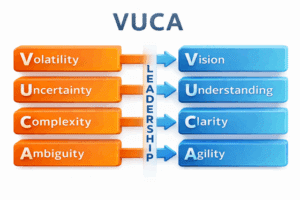
What we are experiencing is often described through the concept of VUCA.
Living in a VUCA world
VUCA stands for Volatility, Uncertainty, Complexity, and Ambiguity. It describes a world where change is rapid, outcomes are unclear, systems are interconnected, and cause and effect are rarely obvious in real time.
In a VUCA world, leadership is no longer about having the best answers. It is about creating organisations that can respond intelligently when answers are not yet clear.
This shift changes not only how organisations operate—but also who leaders need to be.
When speed matters more than certainty
In many organisations, decision-making is still designed for stability rather than change. Decisions move up the hierarchy, analyses are refined, risks are minimised, and time passes.
But in a volatile environment, time is often the most critical factor.
Changes are not only threats. They are also opportunities. New customer needs emerge. New markets open. New ways of working become possible. Yet these opportunities are fragile. They appear quickly—and disappear just as fast.
Organisations that wait for perfect clarity often arrive too late. That is why agility has become a defining capability.
Agility is not a method – it is a mindset
An agile organisation is not one that moves fast at all costs. It is one that can sense, decide, and act close to where reality unfolds. This, in turn, requires leaders who are willing to let go of control without letting go of direction.
Here, leadership shifts from control to clarity.
It requires decisions to be made where information is richest—close to customers, operations, and daily work. It also requires people to feel trusted to act within clear boundaries – Here, leadership changes character.
The leader’s role becomes one of setting purpose, defining boundaries, and creating alignment—so others can act with confidence when conditions change. Vision is no longer a slogan on a slide. It becomes a practical tool and guidance for decision-making. When people understand why the organisation exists and what it is trying to achieve, they are far more capable of navigating uncertainty without constant supervision.
Self-awareness as a leadership foundation
However, leaders cannot create trust and agility in others without first understanding themselves.
In a VUCA world, leaders are constantly observed—especially under pressure. How they react to uncertainty, mistakes, and resistance sends powerful signals.
Self-awareness becomes a critical leadership capability:
- Awareness of one’s own triggers under stress
- Awareness of how personal style impacts others
- Awareness of strengths—and blind spots
Equally important is self-control: the ability to pause, reflect, and respond deliberately rather than react impulsively when complexity increases.
Leaders who lack self-control often create anxiety—without intending to. Leaders who demonstrate calm, curiosity, and consistency create stability, even when the environment is unstable.
From individual insight to team understanding
Self-awareness does not stop at the individual level. In agile organisations, teams develop a shared understanding of how they work together.
When teams understand each other’s differences—communication styles, decision preferences, and reactions to change—collaboration improves. Misunderstandings decrease. Trust grows.
This shared insight creates a common language:
- A language for giving feedback
- A language for addressing tension early
- A language for making better decisions together
Trust is not built through intention alone. It is built through daily interactions where people feel seen, heard, and respected.
Innovation requires courage – and room for failure
Agility and innovation go hand in hand. Yet innovation is often praised in words and punished in practice.
True innovation demands experimentation. And experimentation inevitably leads to mistakes.
Organisations that thrive in a VUCA world understand this. They do not glorify failure—but they treat it as information. A source of learning. A necessary step toward better solutions.
This requires psychological safety—the shared belief that it is safe to speak up, challenge assumptions, take responsibility and make decisions without fear of blame.
Psychological safety does not emerge by chance. It is actively shaped by leaders who:
- Ask genuine questions
- Admit when they do not have the answer
- Respond constructively to mistakes
- Encourage dialogue over defensiveness
The leader’s dual responsibility
Leading in a constantly changing environment requires leaders to hold two perspectives at the same time.
- On one hand, there is performance: results, priorities, execution, and progress.
- On the other, there is organisational health: trust, learning, collaboration, and psychological safety.
These are not competing agendas. They are mutually reinforcing.
Organisations that focus only on results may deliver in the short term—but struggle to adapt. Organisations that focus only on culture may feel good—but lose direction.
Sustainable success emerges where both dimensions are actively led.
Creating organisations that can navigate uncertainty
Leading in a VUCA world is not about predicting the future. It is about preparing the organisation to meet it—whatever it may look like.
This means building organisations where leaders:
- Lead with clarity rather than control
- Develop self-awareness and self-control
- Foster shared understanding within teams
- Build trust through consistent behaviour
- Create psychological safety as a foundation for action
Such organisations do not avoid change. They use it.
And in a world where the ground keeps moving, leadership that starts with self-insight and ends with collective trust may be the most important capability of all.
Henrik Hjorth